We are a full-service digital agency dedicated to creating, developing, and marketing high-performing digital experiences. From initial concept to final growth strategy, we blend innovative design with robust development to help your brand thrive. Our end-to-end solutions ensure your digital presence is seamless, impactful, and built to drive measurable results.
25%
Increase in conversions after engaging with Tecbot for a UX/UI overhaul
68%
Increase in ticket sales with the launch of a new ticketing platform
60%
Decrease in cost per acquisition after moving paid media campaigns to Tecbot
243%
Increase in sales across digital channels after a website redesign and ongoing digital marketing campaign management
About us
Driven by creativity and powered by technology, we turn ideas into impactful results. Our focus is centred around the integration of three pillars - Design, Build & Reach.
We are a full-service digital agency dedicated to creating, developing, and marketing high-performing digital experiences. From initial concept to final growth strategy, we blend innovative design with robust development to help your brand thrive. Our end-to-end solutions ensure your digital presence is seamless, impactful, and built to drive measurable results.
25%
Increase in conversions after engaging with Tecbot for a UX/UI overhaul
68%
Increase in ticket sales with the launch of a new ticketing platform
60%
Decrease in cost per acquisition after moving paid media campaigns to Tecbot
243%
Increase in sales across digital channels after a website redesign and ongoing digital marketing campaign management
About us
Driven by creativity and powered by technology, we turn ideas into impactful results. Our focus is centred around the integration of three pillars - Design, Build & Reach.
Webflow vs. WordPress: Why Tecbot is Architecting the Future on Webflow (2026 Edition)
In the world of enterprise web development, the "WordPress vs. Webflow" debate is a critical architectural decision. For over two decades, WordPress was the undisputed king; the reliable workhorse of the internet. But as the digital landscape has drastically evolved in 2026, so have the performance, security, and scalability needs of our clients.
At Tecbot, we are frequently asked why we have pivoted our core infrastructure focus toward Webflow. The answer isn't just about adopting "new" technology; it’s about reducing technical debt, securing our clients' Google rankings in the age of Answer Engine Optimization (AEO), and empowering their internal teams.
Here is a high-level, analytical breakdown of how these two platforms stack up, and why Webflow is Tecbot's definitive choice for the modern web. (See also: Webflow’s Official Comparison)
1. Total Cost of Ownership (TCO): Predictability vs. The "Plugin Tax"
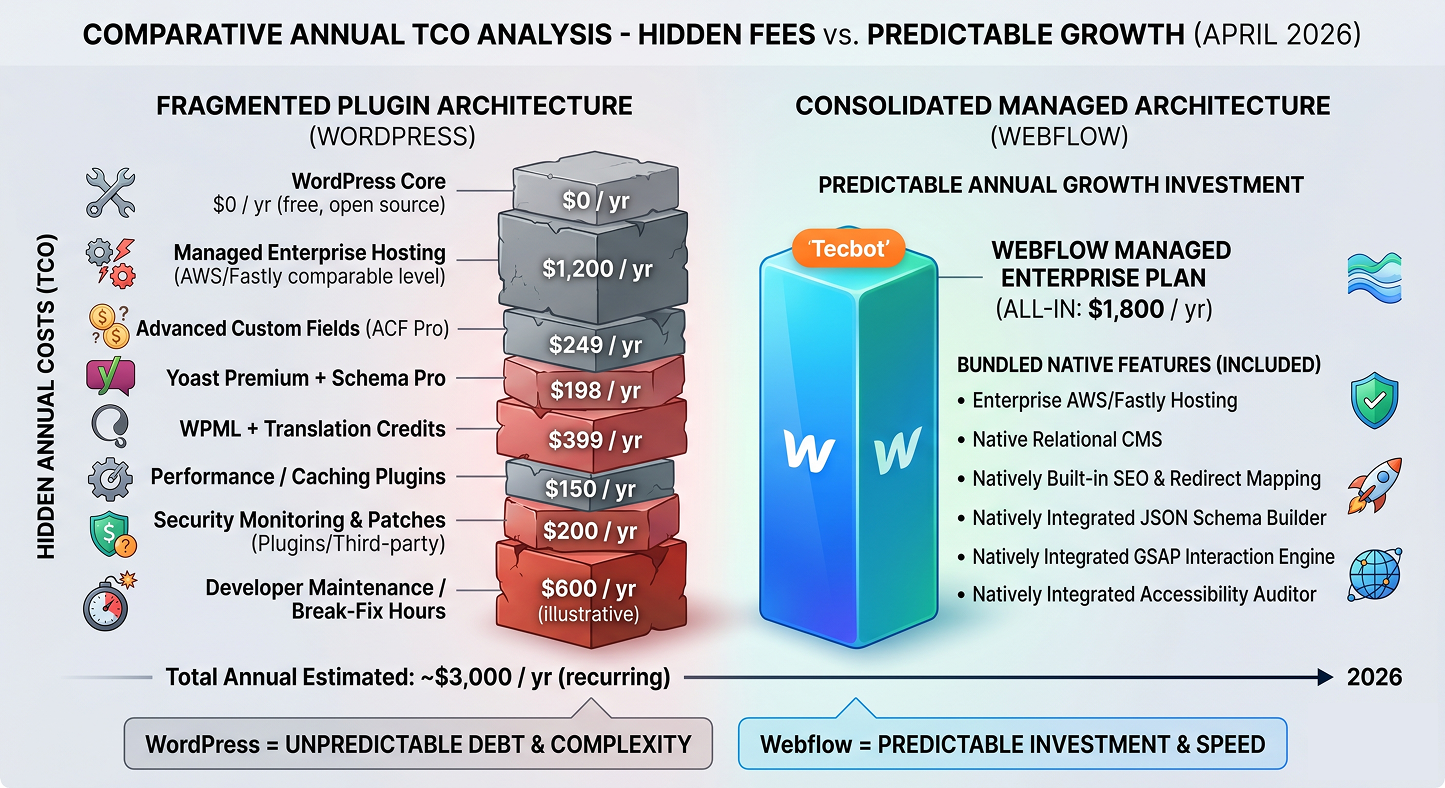
One of the most pervasive myths in web development is that WordPress is "free." While the core open-source software costs nothing, the Total Cost of Ownership (TCO) tells a vastly different story.
The WordPress Reality: You start with a free core, but enterprise functionality requires a labyrinth of premium plugins. Want custom database fields? You need Advanced Custom Fields (ACF Pro: $49–$249/year). Need reliable SEO schema? Yoast Premium ($99/year). Multilingual routing? WPML (€99/year + variable translation credits). Factor in the "Maintenance Tax", paying a developer hourly to ensure these disjointed plugins don't crash your site during routine updates, and the price tag becomes a highly unpredictable financial drain.
The Webflow Edge: Webflow operates on a transparent, consolidated architecture. Your enterprise-grade AWS hosting, relational CMS, and security protocols are natively bundled. While the initial subscription might look higher than budget shared hosting, the long-term TCO is significantly lower (as of April 2026). You are not paying for recurring third-party licenses or emergency developer hours to fix broken updates.
The Tecbot Take: We prefer Webflow because it guarantees cost certainty. You know exactly what you’re paying for, allowing you to invest your budget into marketing and growth, rather than just "keeping the lights on.
Note on pricing: The illustrative $1,800/yr Webflow figure represents a high-end, fully managed agency tier. Standard, self-managed Webflow CMS plans eliminate plugin fees entirely and start at approximately $276/year.
2. Infrastructure & Maintenance: Peace of Mind vs. The Update Cycle
If you’ve ever experienced the dreaded "White Screen of Death" on a WordPress site after a routine plugin update, you understand the operational risk of DIY maintenance.
The WordPress Reality: WordPress requires constant, manual vigilance. You are responsible for updating the core software, the theme, and every single third-party plugin. If one line of code in an updated plugin conflicts with your theme, the entire site architecture can fail.
The Webflow Edge: Webflow is a secure, managed ecosystem. Webflow’s engineering team handles the global CDN hosting, core updates, and security patches autonomously in the background. There are no manual updates, and therefore, zero update-related downtimes.
The Tecbot Take: For our clients’ marketing teams, this managed infrastructure means they can confidently publish content, swap assets, or launch campaigns without the anxiety of breaking the site.
3. Performance & AEO: Built for AI-Era Speed
In 2026, site latency isn't just a UX issue; it is a strict penalization metric for Google’s Core Web Vitals and a barrier to AI search visibility.
The WordPress Reality: Performance is often heavily compromised. Layering 15+ plugins onto a site creates massive JavaScript and CSS bloat. To force a WordPress site to load quickly, developers must paradoxically install more plugins for caching and image optimization, further compounding the technical debt.
The Webflow Edge: Webflow generates exceptionally clean, semantic code. With a built-in Global CDN (Fastly) and native GSAP integration for lightweight animations, Webflow sites achieve lightning-fast render speeds out of the box. Furthermore, as of October 2025, Webflow includes a native JSON schema builder, ensuring your site is perfectly structured for Answer Engine Optimization (AEO).
4. Ecosystem Integrity: Native Solutions vs. Fragmented Integration
WordPress is famous for its repository of 50,000+ plugins. But from an enterprise security standpoint, is more actually better?
The WordPress Reality: If you can dream it, there’s a plugin for it. However, every third-party plugin you install acts as a potential backdoor for security vulnerabilities or a catalyst for database bloat (e.g., translation plugins like WPML duplicating thousands of database rows).
The Webflow Edge: Webflow champions ecosystem integrity. Instead of relying on a fragmented plugin market, Webflow builds crucial features natively, such as Native Localization for global routing and a fully integrated CMS. Where external connections are needed, Webflow prioritizes deep, stable API integrations (via Webflow Apps) with vetted enterprise tools like Salesforce, HubSpot, and Google Analytics.
5. Support & Compliance: Professional Education vs. Forum Hunting
When your team needs to scale operations or ensure legal compliance, the support infrastructure is critical.
The WordPress Reality: Because WordPress is open-source and decentralized, support is highly fragmented. Finding a solution often involves scouring forums from 2018 or chasing down an independent plugin developer who may no longer support their software. Compliance (like ADA/WCAG accessibility) requires expensive external audits.
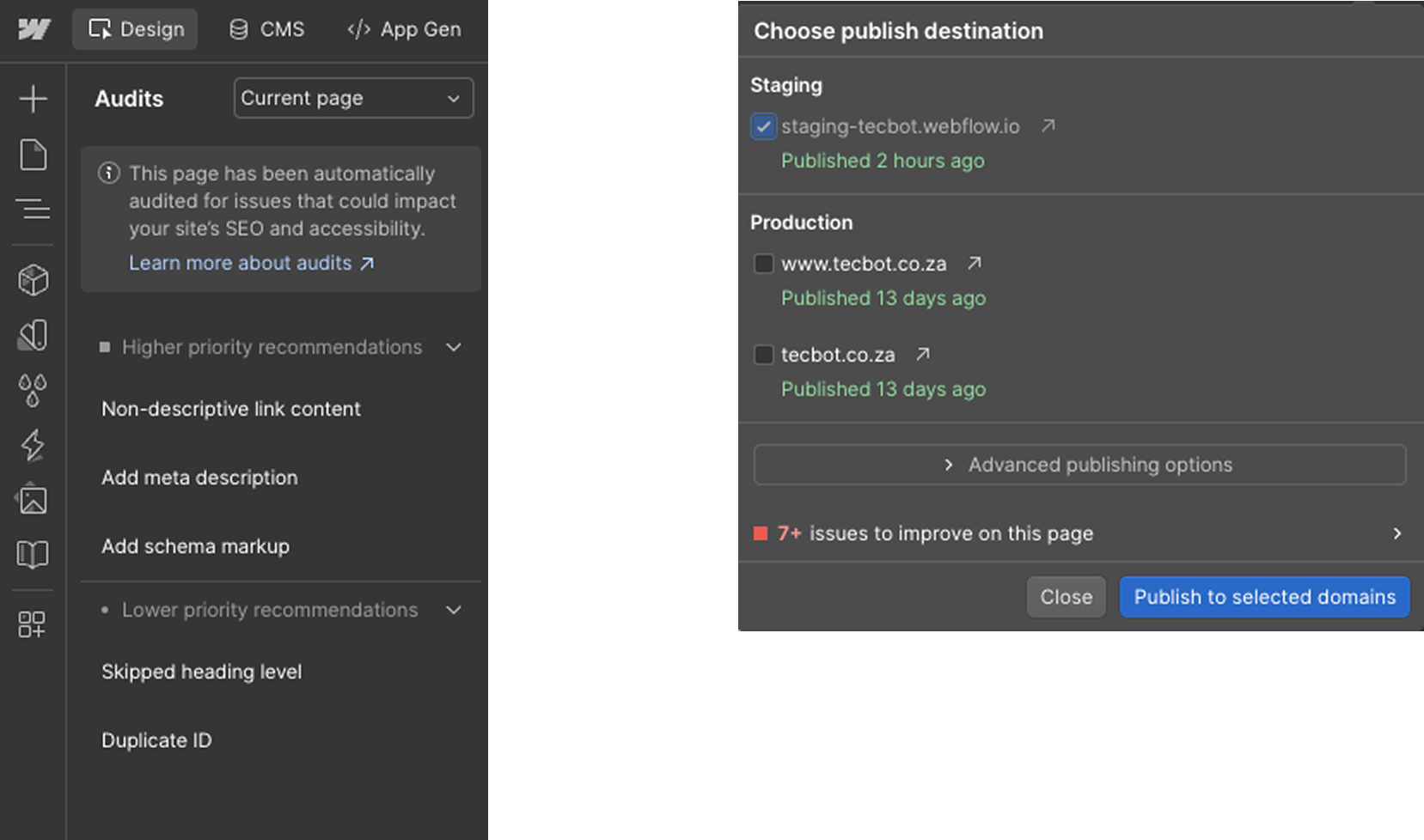
The Webflow Edge: Webflow invests heavily in enterprise support. Not only do you have access to Webflow University, arguably the best software documentation in the industry, but you also benefit from built-in compliance tools like the Accessibility Auditor, which actively scans your site for visual and structural barriers before you ever hit publish.
At Tecbot, our mandate is to deliver a digital product that serves as a high-performance engine for your business, not a fragile technical burden.
We exclusively build on Webflow because it allows us to architect bespoke, highly secure, and blazing-fast web applications that our clients actually enjoy operating. We want your marketing team to feel fully empowered to update a headline, launch a localized landing page, or publish a blog post in seconds, without ever needing to call us for a "technical emergency."
Architectural Comparison Matrix (Data accurate as of April 2026)